
Is Collagen a Peptide?
What Every Woman Should Know Before Buying a Tub
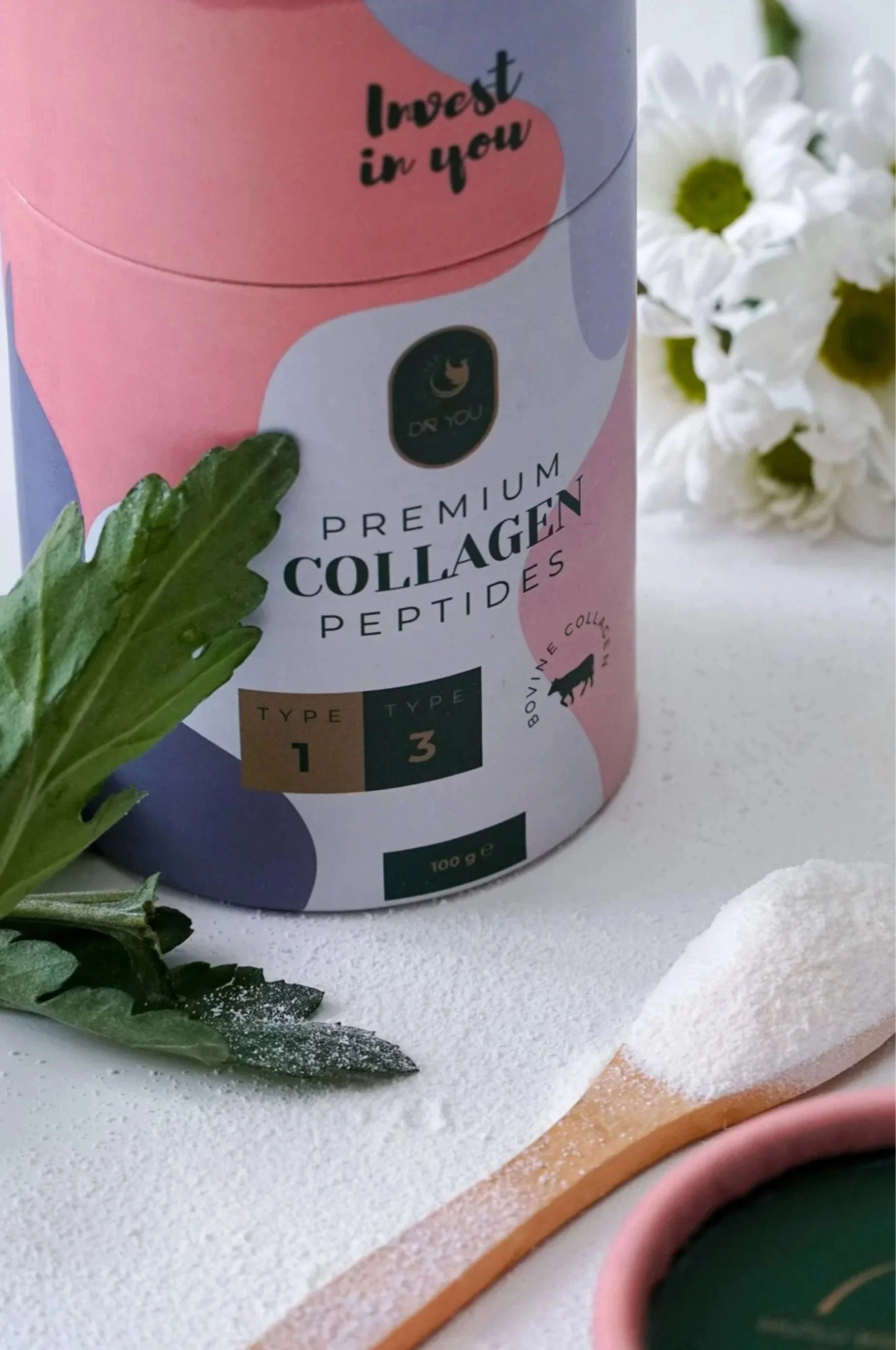
Short answer No. Collagen is a protein built from many peptide chains and the things sold as "collagen peptides" are small, pre-broken-down fragments of it. Here's why that difference decides whether your money is well spent.
Walk down any supplement aisle and the word collagen shouts at you from a dozen tubs. Collagen peptides. Hydrolyzed collagen. Marine collagen. For skin, for joints, for "ageing gracefully." And many ask “is it worth it, and what is it?”
So let's break what collagen is, what peptides are, how your body really uses them and what it means for you whether you're 25, pregnant, deep in perimenopause or well past it.
What is collagen?
Collagen is a protein that is the most abundant protein in your entire body. Around a third of all the protein you're made of is collagen. It's the scaffolding: the structure inside your skin that keeps it firm, the cords of your tendons and ligaments, the cushioning in your joints, and a large part of the framework your bones are built on.
Up close, collagen is three long chains of amino acids twisted tightly around each other, like strands of a rope. That triple twist is the secret to its strength it resists stretching and holds its shape, which is exactly what you want from the material holding your body together.
What is a peptide, then?
A peptide is simply a short chain of amino acids. Think of it as a few beads on a string, anywhere from two to around fifty. Proteins like collagen are made of much longer chains, folded and twisted into complex shapes.
So the relationship is this: collagen contains peptide chains the way a rope contains threads. The thread and the rope are related but calling collagen "a peptide" is like calling a rope "a thread." Too small a word for the thing.
So what's in the tub? (The "hydrolyzed" bit, decoded)
Here's where it gets practical. That triple-twisted collagen rope is far too large for your gut to absorb whole. If you ate pure intact collagen, your digestive system would have to chop it up first and depending on age and the health of your digestion, that chopping varies from woman to woman.
"Hydrolyzed collagen" and "collagen peptides" mean the manufacturer has done the chopping for you: the big protein has been broken down using enzymes or heat into small fragments that pass easily into your bloodstream. Nothing mystical. Pre-digestion, done in a factory.
How your body actually uses it
This is the part the adverts skip, and it changes how you judge every collagen product.
When you take collagen peptides, your body does two things with them:
Uses them as building blocks. The fragments are broken into amino acids your body can use to build its own fresh collagen in skin, joints, bone, wherever it decides it's needed.
Reads some of them as messages. Certain fragments act like reminder notes to your collagen-making cells (fibroblasts), nudging them to increase production.
Notice what's missing: any direct route from the tub to your face. You are supplying ingredients and a work order and your body does the building, on its own schedule. This is why the credible studies on skin elasticity and joint comfort involve taking collagen consistently for 8 to 12 weeks. Anything promising visible change in days is marketing, and not truthful.
Why women should care more than anyone
Collagen is on a timer, and the timer runs differently for us:
Production peaks in your twenties, then declines roughly 1% a year from your mid-twenties onward. Quietly, invisibly.
Pregnancy and breastfeeding draw heavily on your protein stores your body is stretching, carrying and repairing skin, core and pelvic floor with collagen-hungry processes.
Perimenopause is the cliff edge. Oestrogen helps maintain collagen, and when oestrogen falls, collagen loss accelerates sharply as research suggests skin loses a large share of its collagen in the first few years after menopause. Skin thins. Joints complain. And bone, which is roughly one-third collagen framework and weakens faster.
The same thread runs from the wrinkle-cream aisle to the hip-fracture statistics. It's one story, told across decades, and it's why this conversation belongs to women's health and never just to beauty.
What each decade needs
20s–30s: you're at or near peak production which is the building years. Eat enough protein so what you bank now is what the later decades draw on.
Pregnancy & postpartum: protein needs are higher than most mums realise, breastfeeding especially. Nourish the repair don't diet it away.
40s (perimenopause): the decline steepens. This is the decade to take the foundations seriously including or increasing protein, strength training, sleep with or without a supplement.
50s and beyond: skin, joints and bone become one conversation. Strength work plus adequate protein is the non-negotiable base and collagen can sit on top, never instead.
The halal question nobody on the label answers loudly
A large share of collagen on the market is porcine (pig-derived) or bovine from non-halal slaughter. If this matters to you and for my readers it does, look specifically for halal-certified bovine collagen or marine (fish) collagen, which is the cleanest route. If the label won't tell you the source, that silence is your answer: move on. (I will share some soon)
Your kitchen got there first
Before the tubs existed, our grandmothers were already making collagen drinks, they called it yakhni, bone broth, slow-cooked meat on the bone, chicken wings, trotters. Collagen-rich food has been in our food heritage all along.
And your body builds collagen from everyday ingredients: protein (meat, fish, eggs, dals, yoghurt) plus vitamin C, which is essential to the assembly process (lemon squeezed over your food, peppers, amla). A tub can top this up. It cannot replace it.
So... should you buy one?
My honest verdict: the research on collagen peptides for skin elasticity and joint comfort is genuine and promising and modest. It works as a supplement in the true sense of the word and something added to a foundation.
If the foundations are missing like broken sleep, little protein, no strength training then a collagen tub is an expensive sprinkle on an empty plate. And one signal no powder can send. Your tendons, bones and the collagen inside them strengthen in response to being used in muscles pulling, weights lifted, body worked. The tub whispers. The weights shout.
If you do buy: choose hydrolyzed collagen / collagen peptides, confirm halal sourcing, pair it with vitamin C, take it daily for 8–12 weeks before judging, and keep lifting.
Key takeaways
➤ Collagen is a protein. A triple-twisted rope of amino acid chains, and the most abundant protein in your body.
➤ Peptides are short amino acid chains; "collagen peptides" are pre-chopped fragments your gut can absorb.
➤ Your body uses them as building blocks and signals. To see potential results take 8–12 weeks of consistency, never days.
➤ Women lose collagen on a timer: ~1% a year from the mid-20s, sharply faster after menopause.
➤ Check halal sourcing much of the market is porcine. Halal bovine or marine are your routes.
➤ Food, protein, vitamin C and strength training are the foundation. A tub is only ever the topping.
FAQs
Is collagen a peptide or a protein? Collagen is a protein a large one, built from multiple long amino-acid chains twisted into a triple helix. Peptides are much shorter chains. "Collagen peptides" are small fragments produced by breaking collagen down.
Are collagen peptides halal? It depends entirely on the source. Much collagen is porcine or from non-halal slaughtered cattle. Look for halal-certified bovine or marine (fish) collagen, and avoid products that don't declare their source.
How long does collagen take to work? Studies showing benefits for skin elasticity and joint comfort typically involve daily use for 8–12 weeks. Nothing credible happens in days, because your body must break collagen down and rebuild its own.
Do women need collagen more after 40? Collagen production declines from the mid-twenties and accelerates sharply when oestrogen falls in perimenopause and menopause affecting skin, joints and bone. The foundation at every age is protein, vitamin C and strength training. Supplements are optional on top.
Can food replace collagen supplements? Your body builds collagen from protein and vitamin C in ordinary food, and traditional dishes like yakhni/bone broth and slow-cooked meat on the bone are naturally collagen-rich. Supplements are a convenience, never a requirement.
This article is general education, written for women who want to understand their bodies. It is never a substitute for advice from your own doctor, especially if you have health conditions or take medication.